FAIRFIELD – First Selectperson Christine Vitale’s administration will begin implementing a program to make local streets safe as part of a $300,000 federal grant procured through federal transportation agencies.
“This grant helps to fund our road safety campaign for Fairfield,” said Vitale, who is carrying out the program as part of her late predecessor Bill Gerber. “The Federal Highway Administration (FHWA) and U.S. Department of Transportation funding is an important source of revenue that helps us to direct taxpayer funds to other important town (projects).”
The grant is a continuation of the Fairfield Safe Streets Alliance program that was announced in June 2025, just prior to Gerber’s death from a brain tumor.
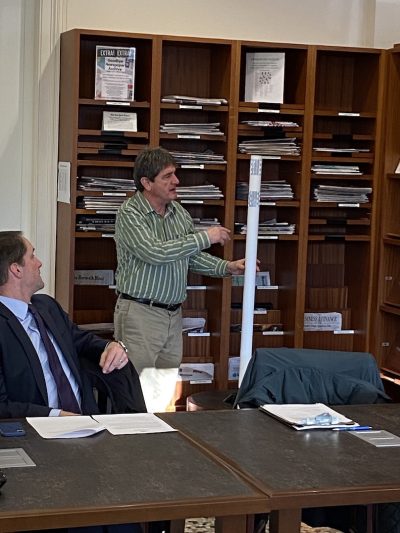
“This grant is extension of a previously award safety action plan, which provides a roadmap to prioritize high injury and fatality locations in the town,” William Hurley, the town’s engineering manager said during a press conference Jan.29 at the Westport Library. “The intent is to reduce speed, increase safety for non-motorized users and to follow up on the town’s commitment to Vision Zero.”
The town will need to finalize an agreement with the FHWA, go through the town boards to formally accept the grant and then hire a consultant, Hurley said. Throughout the process, there will be public input through surveys and meetings.
Hurley and Vitale were joined by U.S. Rep. Jim Himes, Fairfield Chief of Police Michael Paris, Town of Fairfield Director of Public Works Frank Petise and Sarah Roy, past chair of the Fairfield Bicycle and Pedestrian Committee as they announced the federal demonstration grant.
Chief Paris pointed out the need for making the streets safer.
“In 2025, we’ve had 1,925 crashes, 323 involving injuries,” he said. “What’s scary is that injury crashes are preventable. By using all of these tools in our tool chest we have the ability to make effective change in Fairfield.”
Hurley explained how the grant will be implemented during peak congestion hours when cut-through drivers use school zones, residential streets and areas where there are older adults.
“This federal demonstration grant will enable the town to implement short-term demonstration activities as a prelude to future construction projects containing the proven safety counter-measures traffic-calming devices and measures,” Hurley said. “Examples are planters, speed tables, curb extension and delineator posts and temporary removable traffic-calming (tools).”
A delineator is a retro-reflective, vertical marker similar to a traffic cone temporarily installed along roadsides, curves, or work zones to guide traffic, mark alignment, and enhance visibility. Hurley mentioned that is one of the many tools at the town’s disposal as it tries to determine which areas in town need roads to be narrowed for safety.

“The Safe Streets process is a process that involved planning and demonstrating that ultimately results in construction and changes to our physical environment,” Himes said. “Safe Streets takes a community like Fairfield, which in many instances runs very substantial safety risks.
“We want children to be able to walk to the store or walk to school (on such roads near the Westport Library, for instance).
“And that is a huge management problem. If you get it right, you got a community where at least two wonderful things are true: No. 1 a lot fewer motor vehicle accidents without condition. It also creates for a much more vibrant downtown where people can walk and get that exercise that we know is so healthy.”