FAIRFIELD – Local supermarkets continue to struggle with an egg shortage and the subsequent high prices caused by a dearth of eggs because of impact of the H5N1 avian bird flu. In order to control the supply of eggs in their stores, some stores have limited how many customers can purchase.
A recent tour of area supermarkets showed prices for eggs fluctuating from $6.99 a dozen and $10.49 for 18 eggs at ShopRite to $8.49 a dozen at Stop & Shop to $6.89 a dozen for organic pasture-raised large brown eggs at Trader Joe’s. In the case of Trader Joe’s, by 2:30 p.m. on Monday, Feb. 10 there were no eggs left. They were replaced in the shelves by organic strawberries.
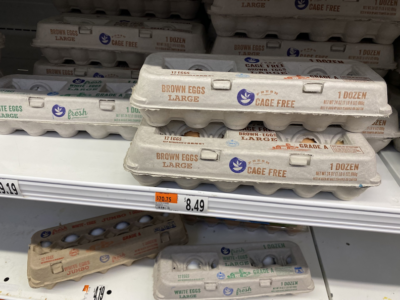
In Fairfield supermarkets such as Trader Joe’s, Stop & Shop, and ShopRite there are signs communicating the higher prices and low amount of egg supply. Trader Joe’s at 2258 Black Rock Turnpike has routinely been running out of eggs by midday, Stop & Shop at 760 Villa Ave. and ShopRite at 1975 Black Rock Turnpike have half-empty shelves.
The sign at Stop & Shop reads: “Egg supplies have been affected because of the continuing bird flu outbreaks. This has led to cost increases from our suppliers and higher prices across the country. We apologize for the inconvenience and are working hard to ensure eggs continue to be in stock. Thank you for your patience.”
The Cingari-owned ShopRite sign reads: “Dear Valued Customer, Repeated outbreaks of Avian (Bird) Flu have affected the supply of eggs. As a result, we have seen higher costs from our suppliers. We will continue to work with our suppliers to ensure availability.”
Both stores included a link to the U.S. Centers for Disease Control and Prevention (CDC) H5N1 Avian Flu update web page.
One customer outside the Stop & Shop store on Villa Avenue isn’t sure how much longer he can afford to keep buying eggs.
“It’s too high,” said the customer, a New York Yankee fan, who would only identify as the “Yankee man.” “But still, don’t take it out all on us. Yeah, I’ve been buying eggs. It’s my breakfast meal. Bacon and eggs and sausage and eggs. I barely can afford the dozen.
When asked what he thought could be done to rectify the situation, he responded that someone should do something.
“They should do something because people are not going to buy eggs because they are too damn high. All my life since I’ve been born, I’ve never seen the price of eggs that high. Never. It don’t make sense that we got to suffer.”
As of Feb. 12 the CDC reported there were 157,774,658 poultry affected by the virus in 51 jurisdictions throughout the country. It reports 68 confirmed human cases of the disease and one death. Since the fall of 2024, the CDC has been reporting the virus had spread to thousands of chicken farms.
Since there is no known way to treat the virus, the only way farms can address the problem is by culling, or killing, the infected chickens.
The U.S. Department of Agriculture (USDA) reported on Jan. 21 that the amount of eggs produced was down 2% from last year. “All layers in the United States on January 1, 2025 totaled 369 million,” the report stated. “The 369 million layers consisted of 304 million layers producing table or market type eggs, 61.2 million layers producing broiler-type hatching eggs, and 3.91 million layers producing egg-type hatching eggs. Rate of lay per day on Jan. 1 averaged 78.6 eggs per 100 layers, down 1% from Jan. 1, 2024, the USDA reported.