BY CASSIDY GODA
Cassidy Goda is a Pre-Law/ Political Science Major at Skidmore College. She serves on the Saratoga Springs Democratic Committee, is the Vice President of the Skidmore Democrats, as well as an assistant in the political science department
In February 2019, the border of Venezuela became a deadly stage for confrontation. The U.S. attempted to have humanitarian aid convoys enter the country, despite Nicolás Maduro’s blockade. Venezuelan security forces fired tear gas and metal pellets at protestors, with at least two people left dead, 300 people injured, and aid being set on fire.
The Trump administration pointed to the burning vehicles as evidence of Maduro’s cruelty, labelling him a tyrant with intent of destroying supplies for his own suffering country. However, video analysis by The New York Times showed it was the Opposition forces who had lit the fire accidentally with a Molotov cocktail striking one of the trucks.
Despite this contradiction, the Trump administration uses this accident as proof of Maduro being a corrupt leader. Trump’s very aggressive stance against Maduro is very puzzling, given his history of leniency with other corrupt governments. Trump has shown mercy for Saudi Arabia, the Philippines, and Honduras, all of which are seen as corrupt states.
With this in mind, why is it that Trump treats Venezuela with far greater aggression?
The Trump administration’s excessive focus and aggression towards Venezuela can be explained by a combination of strategies: the electoral incentives in Florida, building a political platform around anti-socialism, and competition with Russia, China, and Cuba. Together, these factors make Venezuela an appealing target for the U.S., as it would provide political gain, ideological messaging, and a geopolitical advantage.
Background
Under Nicolás Maduro, Venezuela experienced an extreme deepening of authoritarian rule and a drastic economic collapse, which has altered both political and social life in the country. Human Rights Watch reports that there has been little to no justice in Venezuela for the victims of unlawful killings, false arrests, and torture committed by the security forces, all of which were known or agreed to by Venezuelan high-level authorities.
The government has also expanded its abuse of power to regulate the media and close news outlets with opposing views, which has created an environment of self-censorship among journalists due to a deep fear of unlawful punishment for their work.
At the same time, Venezuela’s economic crisis intensified into one of the most extreme collapses in a non-conflict country. The International Monetary Fund found that the real GDP in Venezuela has contracted by more than 75% between 2013 and 2021, which is the largest economic collapse for a non-conflict country in nearly half a century. As the economy got worse, social conditions deteriorated with it. Income poverty nearly tripled from 33.1 percent of the population in 2013 to about 96.2 percent in 2019/2020, and extreme poverty has increased almost sevenfold to 79.3 percent in this same period.
Due to these conditions, displacement shot up, with nearly 7 million Venezuelans, about 23% of the population, fleeing the country by August 2022.
The depth of Venezuela’s political and economic collapse set the stage for Trump’s administration to pursue an unnecessarily aggressive policy toward Maduro. The administration has embraced a term called a “maximum pressure” strategy, portraying Maduro as both a dictator and an illegitimate leader, and using his actions to justify U.S. intervention. Trump imposed sanctions on dozens of officials and increased rewards for capturing/convicting leaders, including Maduro, to try to have Maduro cede power.
By this point, the span of sanctions that Trump imposed limited avenues for possible escalation. Despite the Trump administration’s aggressive stance toward Venezuela, its approach to other governments that are accused of being corrupt and committing human-rights abuses was much more restrained.
After the murder of journalist Jamal Khashoggi, Trump publicly reaffirmed the U.S.-Saudi relationship, where he emphasized the importance of strategic and economic relations, rather than retaliation against Crown Prince Mohammad bin Salman. He even stated, “but it could very well be that the Crown Prince had knowledge of this tragic event— maybe he did and maybe he didn’t!”
Similarly, in a 2017 call with President Rodrigo Duterte of the Philippines, Trump praised Duterte’s handling of the drug war, despite widespread reports of him conducting illegal executions and systematically targeting poor communities by security forces. In addition to this, President Juan Orlando Hernández of Honduras was persecuted by the U.S. for his involvement in mass drug trafficking operations, yet the administration kept its ties with the state and president. In 2025, Trump granted Hernández a full pardon despite his federal conviction.
These examples demonstrate that harsh punishment against abusive governments was not the administration’s first instinct, raising the question: Why Venezuela?
Causal Factors Behind Aggression
Mechanism #1: Election-Driven Motivation: Florida’s central role in U.S. presidential elections allowed for Venezuelan policy to become a political tool for the Trump administration. Florida’s large Cuban American, Venezuelan, and Nicaraguan American populations, many of whom fled left-wing authoritarian regimes, paid close attention to U.S. policy toward socialism in Latin America. A poll conducted by the Atlantic Council showed that these communities had strong support for a hard stance against Maduro.
The politician who helped appeal to these voters was Senator Marco Rubio of Florida. He urged Trump to escalate pressure on Maduro through sanctions, recognition of Juan Guiadó, and to consider more forceful options.
His aggressive approach toward Maduro’s socialist government aligned tightly with the preferences seen in Cuban Americans, Venezuelan exiles, and Nicaraguan Americans in Florida.
The Trump campaign used Venezuela to create a strong political message against socialism, which he aimed at Florida’s Latino community of voters. In 2019, Trump said at a Miami rally, “The twilight hour of socialism has arrived in our hemisphere” and, “America will never be a socialist country.”
This rhetoric hit home for voters who associated socialism with trauma and the loss of freedom. Extreme policy on Venezuela created solid political benefits in Florida for Trump, where it was no longer a foreign-policy issue, but a good vote-seeking strategy.
Mechanism #2: Anti-Socialism as a Brand: A second driving factor in the Trump administration’s oppressive stance toward Maduro was the value of positioning the United States as a global critic against socialism. Venezuela became a symbolic case where Trump and his senior officials could frame his administration as a bodyguard for freedom and success against the failures of a leftist governing body.
In Trump’s 2019 State of the Union address. he made this branding clear, “…socialist policies have turned that nation from being the wealthiest in South America into a state of abject poverty and despair.” This was then followed by, “…America will never be a socialist country.”
By directly linking the collapse of Venezuela to socialism, Trump was able to use this crisis as a cautionary tale for U.S. voters, especially targeting those who are skeptical of the Democratic Party’s progressive sector. This turned an international crisis into a partisan symbol. Trump’s senior advisors also helped to amplify this message, one of the most notable being the “Troika of Tyranny” speech by John Bolton, former National Security Advisor to Trump. In his speech, Bolton framed Venezuela as a clear ideological enemy, where he stated, “The Troika of Tyranny in this Hemisphere—Cuba, Venezuela, and Nicaragua—has finally met its match.”
As he puts it, the economic collapse and rise of authoritarianism in Venezuela are embedded in socialism, and these outcomes are seemingly unavoidable. These statements regarding the ‘inherent’ negative outcomes from socialism allowed the U.S. to justify taking a more oppressive approach towards Venezuela, as they have ‘met their match’.
These approaches allowed the U.S. to make Venezuela a key symbol in the Trump administration’s anti-socialist branding. This ideological positioning is a large factor as to why the Trump administration implements harder policies against Maduro, compared to other corrupt governments. Venezuela’s collapse served as a foreign-policy challenge, but more importantly, it was used as a domestic political opportunity to rally voters whose political identity was partly defined by their opposition to socialism.
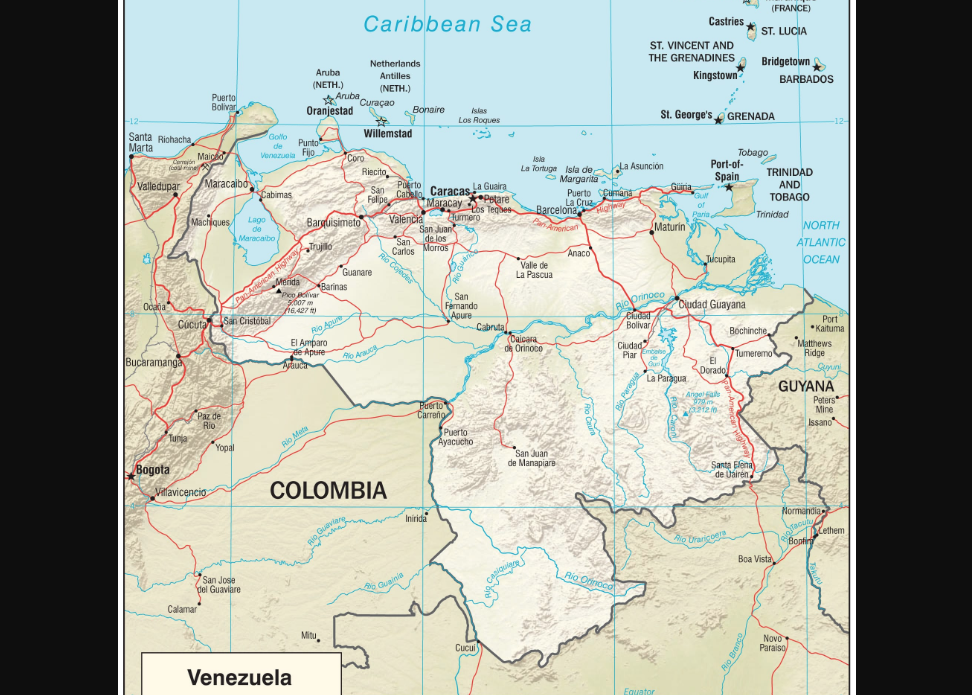
Mechanism 3: Geopolitical Rivalry: A third factor shaping the Trump administration’s aggressive approach toward Maduro was the geopolitical significance of Venezuela. Venezuela is a rare region where Russia, China, and Cuba all hold influence. Unlike other corrupt foreign governments, Venezuela sits in the center of great power interests, which also happen to be rivals. This makes it a strategic battleground for the U.S., and it fits right in with the Trump administration’s broader foreign-policy objectives. Maduro having multiple U.S. enemies supporting him allowed Trump’s administration to frame Venezuela as a proxy battleground to compete for influence.
Russia’s military presence in Venezuela was a key factor in this rivalry. In 2019, Russia sent two Russian air force planes, which had 100 soldiers and 35 tonnes of equipment. This military cooperation demonstrated that Moscow was reinforcing Venezuela at a time when the United States was escalating its aggressive pressure towards Maduro. Russia has been maintaining its role as Venezuela’s primary political and military backer, even through its economic collapse, which drastically limited its ability to purchase advanced weaponry.
China has also emerged as one of Venezuela’s primary external financiers and an essential partner in their oil-based economy. On top of this, China has provided Maduro with technological assistance and surveillance and social control through the ‘homeland card’, which is used by his regime to provide food and medicine to citizens, in addition to tracking voting and social media use of his citizens. Chinese officials are very aware of Venezuela’s economic collapse, and as their biggest creditor, they are bearing the burden of this financial crisis. In February, Geng Shuang, the Chinese Foreign Ministry spokesman, stated, “no matter how the situation evolves, China-Venezuela cooperation should not be undermined.”
This relationship has reinforced to the Trump administration that Venezuela is a site of competition with China. Cuba’s involvement was also significant, especially in the security realm. Cuban advisors and agents have been integrated into multiple levels of Venezuela’s military and intelligence forces by, “providing training, strategic guidance, and logistical support.”
This relationship goes beyond military cooperation. Cuban intelligence services operating inside of Venezuela have helped transfer the same repressive tactics they use on their citizens to Venezuela. Cuban intelligence has also been able to aid Maduro in eliminating potential rivals, and suppressing uprisings before they gain momentum, which reinforces the government’s narrative of control amid chaos. U.S. representatives see Cuba’s involvement in Venezuela as part of a broader hostile coalition against U.S. interests.
These global dynamics shaped how the U.S. has interpreted Venezuela’s crisis. Between 2017 and 2020, the Trump Administration increased economic pressure not only on Venezuela, but also on Cuba, Russia, and China for supporting Maduro.26 Taken together, the involvement of these three U.S. competitors transformed Venezuela into a site of great-power rivalry. Venezuela was not only a failing state but also a platform where the United States could counter its international competitors.
Conclusion
The Trump administration’s unusually aggressive approach toward Nicolás Maduro’s government cannot be explained by humanitarian concern or by aiming to stabilize the region. Venezuela’s collapse did generate mass amounts of human suffering and significant regional migration; this same instability, shown in Honduras, El Salvador, and Guatemala, did not receive the same disciplinary responses.
Florida’s electoral significance, alongside its Cuban, Venezuelan, and Nicaraguan American communities, made an aggressive policy toward Maduro a valuable vote-seeking strategy. Anti-socialism became a key part of Trump’s political identity, and Venezuela was how he could mobilize Latino voters and reinforce a broad anti-socialist narrative. At the same time, Venezuela’s alignment with Russia, China, and Cuba made it a strategic intersection for great-power competition.
Venezuela became the ideal target because it provided benefits to all of the administration’s calculated approaches. The case of Venezuela demonstrated how American pressure is not deployed where abuses are most severe, but where there is a bigger gain domestically.