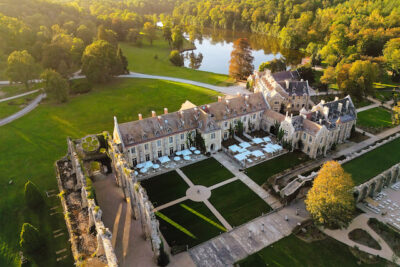
Take the RER suburban railroad from Paris’s Gare du Nord and in about the time it takes to get from Grand Central Terminal to White Plains you will find yourself at the end of the line in Saint-Rémy-Les Chevreuses, a charming French village close to Paris that nonetheless feels as if it is in the deepest heart of the countryside. Worth a visit in its own right, it’s also the stopping off point for getting to an astonishing country house hotel, L’Abbaye des Vaux-de-Cernay.
In truth, “country house hotel” doesn’t quite do L’Abbaye justice. A Cistercian monastery dating from the 12th century, the abbey and its 185-acre estate have been reimagined as a luxurious resort hotel with all imaginable resort-type bells and whistles, coupled with a heavy dose of French je ne sais quoi.

L’Abbaye is the first foray into the world of country hotels for the French group, Paris Society, headed by raffish restaurant wonder boy Laurent de Gourcuff, whose portfolio to date has consisted mainly of restaurants and nightclubs. (Gourcuff is also the chap who has breathed new life into the legendary Maxim’s.) The transformed L’Abbaye is no charming gite (French farmhouse hotel), no intimate Relais & Châteaux hotel, no mom-and-pop guesthouse on the riverbank. Rather, it’s virtually an entire village and not a small one at that, with four restaurants; bars a-plenty; a large swimming pool; a spa and wellness center in the old stables; a boatyard; a cinema; a games room; and goodness me, even a farm with individual family cottages.

There are walks and there are woods; there is a lake, gentle as a Monet painting, which, irrespective of the time of year, shimmers in the early-morning mist. There are bicycles to ride, boats to row and tennis balls to thwack on newly constructed, top-of-the-line hard tennis courts – all meticulously planned with relaxation and recreation in mind. There’s even a kids’ club, affiliated with upscale French kids clothing brand, Tartine et Chocolat, because L’Abbaye, it must be said, is also child- (and pet-) friendly. The vast estate was almost overrun with very well-dressed French children (and equally well-groomed French chiens) the week I visited, which coincided with the French mid-semester holiday break known as Toussaint. Go for it, kids. You’re only young once.
In the main house, magnificent stone-vaulted public rooms lead one into the other, with stone columns and monumental carved fireplaces the dominant feature in each. I couldn’t help thinking how the Baroness Charlotte de Rothschild, a 19th century scion of the European banking dynasty who bought the Abbey in 1878 and rescued it from ruin, must have rattled around in this humungous place, though it’s true she wasn’t short of company. A gifted artist and pianist – who as a teenager had taken piano lessons from Frédéric Chopin, socialite that she was – she loved to entertain, her guests including the composer Georges Bizet of “Carmen” fame and the painters Édouard Manet and Georges Bizet.
Still, heaven knows if she managed to fill all the bedroom. Perhaps there were fewer then, but there are now 145 of them, swagged, chintzed and paisleyed up to the rafters in fabulous fabrics by L’Abbaye’s artistic director, the celebrated Dior designer Cordelia de Castellane.

At the first floor James Bar – named for Charlotte’s brother and also perhaps a kind of homage to those Cistercian monks who, as history relates, were not averse to the occasional flask of ale in hot weather – I took my libations in front of a roaring fire, before heading diagonally across the ground floor to L’Abbaye’s posh-option restaurant, Les Chasses.
Even if you’re not crazy for la chasse (the hunt), even if you’re viscerally opposed to blood-sports, I venture you may yet find the restaurant appealing. With hunting horns decorating the walls and an impressive stone fireplace as its centerpiece, the room is a bastion of good taste, of calm, of beautifully set tables, candlelit in the evenings, exuding warmth in all senses.
A silky poached egg with silken yoke and seasonal girolles mushrooms, from the woods around the estate, makes a wonderful starter, and the classic fillet de boeuf, served with velvety pommes purées (mashed potatoes) in a rich foie gras jus, confirmed this restaurant’s gastronomic credentials. And when your waiter recommends the fish in Dugleré sauce, taking the trouble to explain to you that the sauce was indeed created in the 19th century by Adolphe Dugléré, a pupil of Marie-Antoine Carême (one of the great, legendary chefs), it feels like a kind of living gastronomic history lesson, to the point where it seems wrong not to order the dish. I was certainly glad I did.
Blissfully unstuffy despite the snowy linens and beautiful china, the restaurant welcomes children and, again, there were any number of them on the evening I dined there.
Less formal is the rustic Auberge restaurant, with its wooden beams and red checked tablecloths, where a serving of beef or slow-cooked lamb for one might easily feed a family of four. The atmosphere is laidback, too, at the open weekends-only Trattoria, where you can enjoy excellent linguine al ragù while a guitarist strums those sentimental French and Italian classics.

Breakfast, served in the vast and positively baronial Réfectoire des Moines, is a little like feeding time at the zoo. But it’s a very upscale zoo to be sure, where the quality of the food – a vast buffet with additional hot dishes available to order – and the edifying sight of beautifully-dressed and well-mannered Parisians and their equally well-dressed offspring “tucking-in,” make for an overall delightful experience. The weekend brunch, which I did not experience during my stay, also served in the refectory, is said to be exceptional.
Not everything is perfect, or runs on oiled wheels, though, which gives L’Abbaye a kind of human touch. For instance, at times there were so many agents at the front desk – mostly smiling 20-somethings in L’Abbaye’s zingy, signature tartan – that they seemed like a theater troupe, while at other times there was only one poor trainee left alone to deal with an army of simultaneous check-ins. And a couple of the vast public rooms felt a little chilly in late fall (well, what do you expect from a 12th century abbey?) although this is hardly going to be a problem in spring and summer, when L’Abbaye will be bathed in warm sunshine.

Modeled, so the publicity material had advised, on the typical “English country house hotel,” I was interested to learn that L’Abbaye was something of a mold-breaker for France, that such places, and on such a scale, are actually quite a rarity. This ties in with the historical fact that while the upper-class English traditionally left town to “play” in the country, their French counterparts – especially pre-Revolution – might lead quiet lives during the week on their country estates but would come to Paris at the weekend, for, er, “recreation.”
Nowadays, though, no such distinctions need be made. On weekdays or at the weekend and in any season, L’Abbaye des Vaux-de-Cernay makes an unforgettable experience, a magnificent resort on Paris’s doorstep. If you possibly can, be sure to add a couple of days to your City of Lights itinerary to enjoy it.

Jeremy Wayne is a travel adviser with Superior Travel of New York. Email him at jeremy@superiortravel.com.