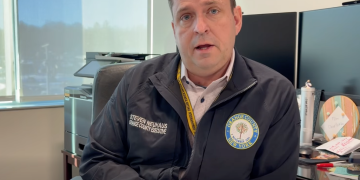
Nathaniel Beers, M.D., MPA, FAAP, wanted to be a pediatrician from the time he himself was a child growing up in Washington D.C. It was a desire reinforced by working at a camp for disabled kids while he was in high school.
“Part of my job is to create a voice for patients and families to be seen and heard,” said Beers, who most recently served as executive vice president of Community and Population Health at Children’s National Hospital in Washington, D.C., and previously held leadership positions across the health, education and social service sectors, as president of the HSC Health Care System and COO and chief of Specialized Instruction for the D.C. Public Schools, along with senior roles in the D.C. Department of Health.
On Nov. 17, Beers became president and CEO of Blythedale Children’s Hospital in Valhalla, succeeding Larry Levine, whose 26-year tenure saw the hospital transformed from a pediatric rehabilitation center founded in 1891 into a nationally recognized specialty hospital serving hundreds of medically complex children each year, one of only 15 such facilities in the country. With an undergraduate degree from the University of Rochester, a medical degree from The George Washington University School of Medicine and Health Sciences and a Master of Public Administration from Harvard University’s John F. Kennedy School of Government,Beers has arrived at a moment when further transformation – as well as challenges – are afoot.
The hospital has applied to the town of Mount Pleasant, of which Valhalla is a hamlet, to increase the number of long-term care beds with “largely new construction,” Beers said. (The 17,000-square-foot Steven and Alexandra Cohen Pediatric Long Term Care Pavilion, which opened in 2016, has 24 beds that are at 100% occupancy.)
Other major building projects since 2011 include a 56,000 square-foot Inpatient Hospital with 94 beds, of which about 80 are occupied; the 8,000-square-foot Robert Stone Day Hospital; the 6,000-square-foot Stavros Niarchos Center for Speech Pathology & Audiology; the Milton Spahn Therapy Village; and a new Simulation Lab and Parent Training Center.
Blythedale also has a Family Resource Center and an Early Childhood Center for young children with special medical needs as well as an on-site public school district, the Mount Pleasant Blythedale UFSD – the only one of its kind in the country. These facilities are all in service of the most fragile kind of 1-percenter. That is the percentage of the pediatric population that Beers said can be described as medically complex – requiring everything from special feeding to recovery from traumatic brain injury. These children, who range from less than a year old to age 18, need intensive nursing and therapy from the roughly 500 full-time staffers, along with part-timers and per-diem employees. (See sidebar.) Parents of patients also need training, as more than 85% of the patients will be going home. The goal is to provide parents with the training and support that will enable the youngsters to receive the same kind of care at home that they do at Blythedale, Beers said.
The medical challenges encountered by these families have been compounded by the cuts to states’ Medicaid funding and coverage contained in the Congressional budget reconciliation bill, H.R. 1. https://www.medicarerights.org/medicare-watch/2025/10/02/states-already-cutting-medicaid-massive-federal-cuts-yet-to-come About 80% of Blythedale patients receive Medicaid benefits.

“We are a safety net hospital,” Beers said. “We are serving underserved communities….It’s not clear yet how New York will implement the changes and whether it will cover the loss.”
What is clear, he added, is that Medicaid cuts would “increase the number of patients we have who are not insured.”
It’s not just the children’s insurance that must be considered. It’s that of the parents, particularly now that coverage under the Affordable Care Act, known informally as Obamacare, is set to spike with its subsidies expire Wednesday, Dec. 31. Four Republican congressmen – including the Hudson Valley’s Mike Lawler – broke ranks to join the Democrats to force a vote in the House of Representatives on extending the subsidies for three years – a vote that will take place in early January.

Meanwhile, the House has passed a Republican-backed bill that instead is designed to expand association health plans, lower premiums for some ACA enrollees and enact reforms aimed at decreasing drug costs. For many families, however, this may be cold comfort.
“When a parent loses coverage, the family is less likely to maintain insurance, even if the children are eligible for other benefits….Parents with a child with disabilities already spend more out of pocket.”
Rising insurance premiums and Medicaid cuts are “putting pressure on already struggling families.”
The pressure is on Blythedale as well. With an operating budget of $123 million, the hospital is projecting a $1 million to $2 million revenue loss as a result of the Medicaid cuts, with 2027 and ’28 being potentially the years of “greatest uncertainty.” Most of the hospital’s revenues come from billable inpatient and outpatient services. The hospital receives $4 million to $4.5 million from philanthropies and is looking at how it can expand giving from this sector.
“We all have something more to give, whether it’s time or money,” Beers said.
In the meantime, the hospital will continue to move forward, expecting staff and patients alike to be fully vaccinated as per the recommendations of the American Academy of Pediatrics (AAP) and the New York state Department of Health. “The population is ever more at risk,” he added.
Just as necessary – the special services Blythedale provides.
“We’re the hospital no one wants to have to use,” Beers said. “But we’re here if you need us.”
Blythedale negotiates with respiratory therapists seeking increased compensation
Blythedale Children’s Hospital in Valhalla is negotiating with respiratory therapists, who held a day of action outside the hospital Dec. 9 to address wages and a pension that they said do not reflect their years of specialized service to medically fragile children and their families.
The respiratory therapists are represented by 1199SEIU United Healthcare Workers East – which has more than 450,000 members throughout New York, Massachusetts, New Jersey, Maryland, Florida and Washington, D.C.
“When I leave work, I leave fulfilled,” said Sevdiana Dzaferovic, a respiratory therapist at Blythedale since 2018. “We understand how valuable the work we do is – and it feels rewarding. But that feeling is not enough. We deserve to be valued as professionals and compensated fairly.”
Added Sean Resto: “We use advanced protocols you won’t find anywhere else. We use the full scope of our training every day. Yet we make $8 to $10 an hour less than other local RTs. We live in one of the most expensive areas in the country and should earn decent wages and be able to retire someday.”
In response ,Nathaniel Beers, M.D., MPA, FAAP, the new president and CEO of Blythedale Children’s Hospital, said: “We value all members of our team and the incredible work they do every day, and we have invested in our staff to ensure they have benefits, including a recently improved retirement benefit, to best meet the needs of their families.
“….While we don’t comment on the details of ongoing negotiations, we are committed to open and respectful dialogue and to supporting our staff as they continue to care for our medically fragile patients.
“Our focus remains on providing safe, high-quality care and ensuring our hospital is a supportive place for everyone who works here.”