Photograph by Kenneth Gabrielsen.
These have not been the best of times for colleges and universities, with federal challenges to curriculum, diversity on campus and granting. Such challenges resonate particularly with schools like Mercy University, celebrating its 75th anniversary of providing educational access and opportunity for all. As a federally designated minority-serving institution and the largest private Hispanic Serving Institution in New York state, Mercy University has a racial composition of 41% Latino, 24% Black, 24% White and 7% Asian among its 7,681 undergraduates and 3,223 graduate students. (When you look at the undergraduate population alone, the minority numbers are higher — 47% Latino, 26% Black and 17% White.)
On Tuesday, Sept. 30, Excelencia in Education, a national organization, announced that Mercy University had earned the Seal of Excelencia recertification. (It was first awarded the seal in 2022.) Mercy is just one of 18 colleges and universities to earn the Seal in 2025, reaffirming its place in a group of nearly 50 institutions dedicated to improving Latino, and all, student success. With 912 faculty members, a staff of 605 and an annual operating budget of $160 million, the university is determined to chart not only the current cultural landscape but its own course.
“Mercy remains steadfastly committed to its mission,” said university President Susan L. Parish, Ph.D., M.S.W. “At a time when we are facing a period of intense scrutiny and shifting priorities in higher education, our work is more important than ever. As you know, earlier this month, the U.S. Department of Education announced the termination of several Title III and Title V grant programs. For universities like ours, these funds have been essential in leveling the playing field for students who have historically been underserved. While this decision does not alter our commitment to serving our diverse student population and upholding our mission as a Hispanic-Serving Institution, it does challenge us to do even more with fewer resources.
“We must ensure that the education we provide continues to open doors, build networks and create access to excellent employment opportunities for Latino students and all students. We have already begun this work through career pathway programs, industry partnerships and curricular innovation, and now we must do even more.”
Founded in 1950 by the Sisters of Mercy, a Roman Catholic order, to provide young women with a college education – and a path to finding a place in the wide world — Mercy is now an independent, coeducational institution with campuses in Dobbs Ferry, the Bronx and Manhattan, as well as online. It offers more than 100 undergraduate and graduate degree programs and certificate programs within six schools — Business, Education, Health and Natural Sciences, Liberal Arts, Nursing and Social and Behavioral Sciences.
Though much has changed over the years, Parish said that in essentials, Mercy remains as it was:
“Mercy’s 75th anniversary is a remarkable milestone that honors the vision of the founding Sisters of Mercy, whose commitment to compassion, service and opportunity continues to guide our institution. I find it incredible that their founding mission remains just as relevant today as it was in 1950. Mercy remains what it has been since its inception – a beacon of access, opportunity and transformation.”

Recently, Westfair caught up with her for a wide-ranging interview on the university’s past, present and future:
Susan, thank you for your time and congratulations to you and Mercy on 75 years of educational excellence. As you look back on your tenure as president but also on the university’s history, what stands out as its major accomplishments?
“A monumental moment during my tenure as president is when Mercy became Mercy University in August of 2023. I was so honored to be a part of it. Becoming a university was the natural evolution for our institution and firmly rooted in Mercy’s founding principles.
Through each decade, the heart of Mercy has stayed the same – opening doors of opportunity, lifting up students and families — and that is truly inspiring. I am proud to be a part of its story.”
What’s new on campus — in terms of programming or facilities, for example – that students are experiencing this fall?
“Beginning with the 2025 first-year students, Mercy University has launched a Work-Based Experience (WBE) component to every academic program. WBE is a form of experiential learning, which may include internships, volunteerism, clinicals, practicums, field work, service-learning or other relevant hands-on experiences.
“Students will complete WBE at various points during their academic journey, with a high concentration in the junior and senior years. Each WBE will be paired with a course component, allowing faculty to track student learning and progress.
“Before beginning a Work-Based Experience, students will receive career preparation that includes personalized one-to-one career coaching, career-integrated curriculum, access to career-related workshops and on-demand resources to support professional development.
“This initiative is part of a broader strategy to prepare students to be work-world ready, enable students to earn a livable wage, exceeding what they would earn with only a high school diploma, position students to pay down student debt and support their families effectively and ensure students are not underemployed upon graduation.

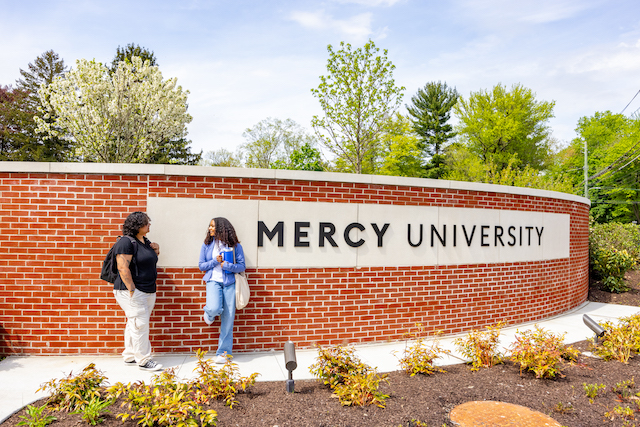
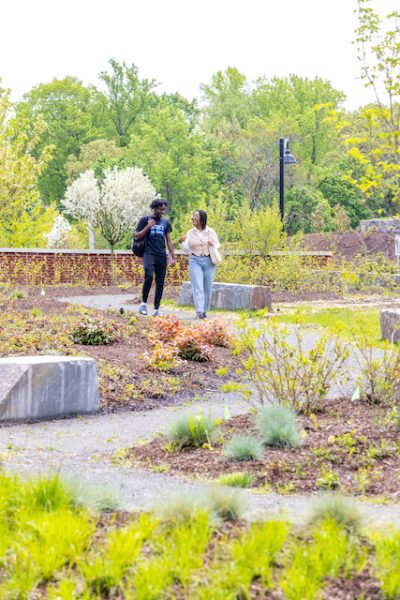
“As for facilities, Mercy has invested in several upgrades to its Westchester campus over the past two years, including redesigning the main entrance that welcomes visitors with the new Mercy University name, a new turning lane to ease congestion, a wider turning radius for buses and a raised table over the Old Croton Aqueduct for traffic and pedestrian safety. The new The Gardens on Broadway offers a place where students can meet to pause during their busy day, recharge and be inspired by nature.
“Another large-scale addition for the community is the incredible 4,100-square-foot open-air pavilion, named in honor of Timothy L. Hall and Lee Nicholson Hall, Mercy’s 12th president and his wife. Located in a high-traffic area of campus, this amazing focal point also serves as a hub of activity, promoting conversation and connection among the entire Mercy community.
“We installed a new four-faced clock in our Westchester campus to commemorate our 75th anniversary. The clock, dedicated on Sept. 20 at Founders’ Festival, is a powerful symbol of our history and future.

“We also recently renovated our athletic fields. New dugouts, a state-of-the-art scoreboard, an enhanced audio system and upgraded netting are just a few of the exciting upgrades that not only elevate the athletic experience but also underscore Mercy’s dedication to providing top-notch facilities for its students and athletes.
“Mercy University is planning several exciting upgrades to the Westchester campus over the next five years. These renovation and building projects aim to enhance student engagement and success by providing a variety of new, thoughtfully designed spaces, including a dedicated student services center, more purpose-built classrooms and labs, more informal social space, new athletic facilities and a more accessible and updated event space.”
Mercy continues to see rising enrollment – with the freshman class surpassing 1,000 for the third consecutive year — at a time when some are questioning attending four-year institutions. To what do you attribute that success?
“Mercy’s long-standing commitment to affordability is as important today as it ever has been. Mercy tuition rate ($23,650 for a full-time undergraduate in the 2025-26 school year), is often half that of most private colleges and universities. We believe students and families are growing tired of the ‘high-cost, high-aid’ model many schools use and appreciate how clear we express cost of attendance.
“At the same time, we are seeing massive growth in our nursing program due to our fantastic outcomes and a wide range of programs. We offer both a traditional, four-year Bachelor of Science in Nursing (BSN) program, an accelerated second-degree program for career changers and robust graduate programs for nurses who want to move into leadership roles. We are also very excited about our new bachelors’ programs in education, which will help address crucial shortages of teachers across New York and the region.
Alfred Baah. Photograph by Kenneth Gabrielsen.
“We also have continued to invest in our infrastructure and offer beautiful campuses and top-of-the-line facilities.”
Mercy is focused on preparing students for high-demand jobs not only in nursing and the rest of health care but in technology and that perennial, business. But we know from our past conversations that you think a well-rounded education, including the arts and humanities as well as STEM (science, technology, engineering and mathematics), is important. Would you elaborate on this?
“A well-rounded education that combines the arts and humanities with STEM is essential today because it helps students develop both technical expertise and human-centered skills. STEM builds strong problem-solving and analytical abilities, while the humanities strengthen communication, creativity and ethical awareness. Together, they prepare students to adapt in a rapidly changing workforce, approach challenges from multiple perspectives and think critically about the broader impact of their work on society.
“This balance creates not just skilled professionals but thoughtful and innovative leaders.
“Advances in areas like AI, for example, raise ethical and social questions. Humanities provide the foundation to think critically about the human impact of these fields.
“A mix of STEM and humanities ensures students are flexible, resilient and prepared for the future. Mercy is undergoing a transformation of our general education model to better connect students to the learning in the classroom, demystifying the college experience and providing students with the skills and lessons needed to remain in college until graduation and obtain a rewarding and successful career upon graduation.”
Many area colleges and universities are partnering with local corporations and other organizations to give their students a leg up. Tell us about some of Mercy’s corporate partners.
“Thanks to an impressive lineup of corporate partnerships, Mercy’s School of Business and Career and Professional Development office are connecting students with leading companies, industry experts and invaluable hands-on opportunities. Mercy’s School of Business has cultivated strong ties with major corporations and firms across multiple sectors. These partnerships open doors for students through mentorship programs, on-site corporate visits and pathways to internships and employment. Students get face time with professionals from organizations such as:
- Abrams Books – accounting;
- C&A Digital Marketing – marketing;
- Community Capital New York – financial services;
- DNY – marketing;
- Deloitte, KPMG LLP, JP Morgan and Co., Con Edison, PricewaterhouseCoopers (PwC), Ernst & Young (EY), Citrin Cooperman, PKF O’Connor Davies, CohnReznick, UHY, Grant Thornton – professional services, finance and energy;
- Global Atlantic Financial Group – financial services;
- Hart Vita and Partners – accounting, consulting and financial services;
- PepsiCo – Food and beverage;
- NordLB – banking and financial services.
“Beyond the partnerships themselves, industry leaders such as Alex Hart, CEO and founder of Hart Vita, and Martin Speckesser, senior director at NordLB, serve on Mercy’s School of Business advisory board. Their input ensures that classroom learning stays relevant to today’s rapidly evolving workplace.
“Meanwhile, through the Career and Professional Development office, students connect with employers in science, health care, technology and more:
- Regeneron: Every year since 2020, 15 to 20 Regeneron scientists have volunteered their time to network with students interested in STEM careers during the company’s Day for Doing Good.
- Health-care employers and NCLEX review weeks: Mercy nursing graduates preparing for their licensing exams meet recruiters from top health-care organizations, including Montefiore Health System, Northwell Health, Summit Health, White Plains Hospital (part of Montefiore), and NYC Health + Hospitals.
- Career fairs: Mercy’s fall fair brings in around 30 employers, while the spring fair draws as many as 60 organizations eager to recruit the university’s rising talent.
“Mercy’s forward-looking collaborations also include a growing relationship with the Westchester Medical Center Health Network, which offers onboarding waivers to smooth the path for Mercy students entering clinical work. In the tech space, Mercy partners with TechWise, which has provided specialized training for aspiring technology professionals over multiple years.
“Mercy’s partnerships ensure students graduate with more than a degree; they leave with the skills, connections and confidence to thrive in their chosen fields. It’s this combination of academic excellence and real-world experience that makes Mercy’s approach to career readiness stand out.”
What else is on the horizon for Mercy?
“Mercy University is committed to expanding its reach and impact by finding innovative ways to address students’ evolving needs and bring education to even more people.
“Mercy University will be a leader in ensuring students who want to transform their lives through education, and particularly first generation and low-income students, can do so.”
If we were to come back to the school 75 years from now, what do you expect we would see?
“Mercy University looks forward to the next 75 years of growth and enrichment – deepening our community ties and finding new ways to ensure students graduate with minimal debt and launch successful, meaningful careers.”