With The Coca-Cola Co. (NYSE KO) and Purchase-headquartered PepsiCo (PEP: NASDAQ) each set to launch pure cane sugar colas for mass American consumption this fall, the question arises: What will these mean for consumers’ health and wallets?
The answer is complex, driven in part by the beverage giants’ desire to engage shifting demographics and greater health consciousness all while hedging their bets.
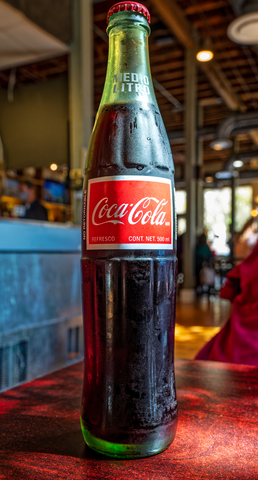
The idea of using import-taxed sugar – as opposed to high fructose corn syrup (HFCS), made from government-subsidized corn — is nothing new for either brand. While each has been using HFCS since 1984, they also produce colas with cane sugar for Passover as high fructose corn syrup is generally not considered kosher. (These colas are identifiable by their yellow caps and kosher certification symbols.) And both companies produce cane sugar colas in glass bottles that are popular in Mexico and throughout Latin America. (This side of the border, you can probably find these in superstores like Costco, Target and Walmart as well as local bodegas.)
Indeed, Coca-Cola is a particular hit in Mexico, with the highest per capita consumption globally. On July 22, Coca-Cola – whose portfolio contains a variety of beverages but no snack foods — reported net revenue of $12.5 billion, up 1% for the same period (April to July) last year and in line with Wall Street. Net income for the quarter rose 58% to $3.8 billion. PepsiCo – with a variety of bevvies and snacks – saw second-quarter revenue rise about 1% to $22.73 billion, beating analysts’ estimates.
But in reporting on Pepsi’s new cane sugar cola, CNBC noted that the company’s “North American beverage volume shrank 2%. Its namesake soda was one of the few bright spots, helped by the success of Pepsi Zero Sugar.”
With Americans more health conscious – which is not to say necessarily healthier – plus pressure from the Trump Administration to use cane sugar; and an ascendant Hispanic population accounting for almost 20% of the U.S. population, the time for the Latin-popular, seemingly more “natural” Coke and Pepsi has arrived. Contrary to what President Donald J. Trump first reported, Coca-Cola isn’t replacing HFCS Coke with cane sugar Coke; it’s just adding it to its stable. Similarly, Pepsi Prebiotic Cola – with five grams of cane sugar, three of prebiotic (good bacteria-nourishing) fiber and availability in cherry vanilla – will join a Pepsi portfolio that includes new $1.95 billion acquisition Poppi, a prebiotic soda. (Coke introduced its fruit-juicy Simply Pop prebiotic soda in February.)

All well and good, but will these make a difference in people’s health? HFCS is made of 55% fructose and 45% glucose; cane sugar (sucrose) is half and half. While fructose and glucose are simple sugars, fructose is considered harder to metabolize, particularly in excess consumption. (For a doctor’s explanation and perspective, see Page 18.) There is the same number of grams of sugar in a 12-ounce can of Coke, Mexican Coke and Mexican Pepsi – 39, the equivalent of about 10 teaspoons of sugar. Pepsi is a bit sweeter, with 41 grams per 12 ounce can. All have 150 calories, except Coke, which has 140.
That would go along with our impromptu taste-test, with Coke and its south-of-the-border counterpart delivering a crisper finish than the Pepsis. (Interestingly, we found Diet Pepsi has a crisper taste than Diet Coke.)
Will any of this matter to Health and Human Services Secretary Robert F. Kennedy Jr.’s war on sugar and artificial sweeteners, this despite his Diet Coke-loving boss? And what about the bottom line, along with the waistline? A 12-ounce bottle of Mexican Coke or Pepsi will run you anywhere from $2 to $6. Those costs may drop when the sodas are presented for mass consumption here.
But ultimately, will the average consumer bite – or rather, sip? Coke and Pepsi aren’t taking any chances, adding “healthier” options while sticking with their best sellers.
After all, many of us remember New Coke. Launched in 1985 partly to compete with a surging Pepsi’s sweeter taste, the soda replaced Coca-Cola’s signature product, resulting in a backlash and public relations nightmare that echoed the Civil War, cola style – with Atlanta-based Coke, introduced in 1886, squaring off against its New York rival, introduced in 1893 — forcing Coca-Cola to bring back its flagship flavor, a taste that has been considered as American as apple pie, blue jeans and rock’n’roll. For a while, Classic Coke and New Coke were both stocked so everyone could save face. New Coke finally died in 2002 – only to reappear every so often in conspiracy theories, books, documentaries and, in 2019, the Netflix series “Stranger Things.”
Strange indeed, or maybe not so strange. The public, with its power of the purse, had spoken. But the jury’s still out on whether sugar cane Coke and Pepsi will supplant their HFCS sisters in the U.S. or remain specialty footnotes to history.