For foreign businesses, the American market can be an intimidating one, even for brands whose countries of origin have deep roots in the United States, as Italy does.
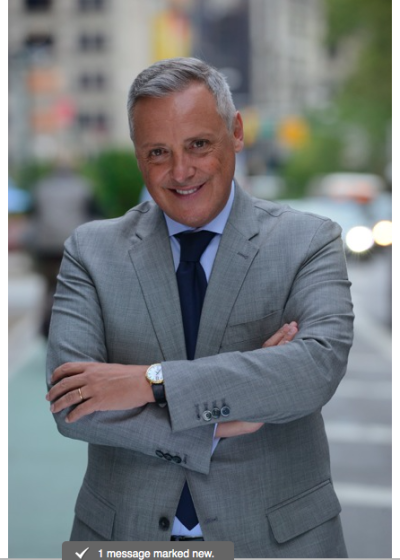
Enter Alberto Milani, with an eye for crafting not only fine jewelry but an entrée into the U.S. marketplace for companies in the Italian food, fashion and travel industries.
After a career in which he held senior leadership roles at such global brands as Procter & Gamble, Sector Sport Watches, Bulgari, Buccellati and Richline Group Inc. (a Berkshire Hathaway Inc. subsidiary), Milani founded his eponymous jewelry brand, Alberto Milani, A Love Affair With Italy, in 2017 and, four years later, co-founded Piazza Italia, which provides some 35 subscribing Italian businesses with what he calls “a menu of services” – accounting, banking, legal, marketing and public relations – as well as an office in midtown Manhattan off Madison Avenue, 11 44th St. to be exact.
For Italian products in the U.S. market, the hurdles go beyond the current geopolitical climate.
“Tariffs are just the tip of the iceberg,” Milani said of the 15% tariff on most Italian imports as per the trade agreement negotiated between the United States and the European Union in July. “Competing successfully now requires not occasional attempts but a permanent structural presence in the U.S. market, a reliable bridge that ensures stability, resilience and visibility for Italian brands.
“This transformation isn’t just about adapting to change; it’s about securing a long-term future where creativity, craftsmanship and authenticity are supported by solid market infrastructure. Piazza Italia was born with this vision — provide exactly the structural presence that ‘Made in ltaly’ needs in the United States. Not predation, but permanence. Not opportunism, but strategy. Not short-lived wins, but enduring partnerships. The challenge is here, but so is the opportunity to build something lasting. Piazza Italia is the answer.
“Our motto is ‘Stronger together,’” added the man who spent more than a decade as president of the 138-year-old Italy-America Chamber of Commerce Inc. and continues to coordinate the activities of such chambers across North America as a board member of Assocamerestero in Rome.
The strength in numbers he referred to has led to bigger numbers. During his career, the Greenwich resident has overseen the sale of more than $1 billion in “Made in Italy” products in the United States, with a good deal of that presence concentrated in such luxe retailers as Bergdorf Goodman, Neiman Marcus and Saks Fifth Avenue, all part of Saks Global Enterprises LLC; as well as Bloomingdale’s, which is owned by Macy’s Inc.
“Bloomingdale’s is one of our best partners,” he told Westfair’s Westchester County Business Journal during an appearance at the Sept. 18 reception for the store’s three-day “Fine Jewelry Showcase.” There Milani represented not only his own brand but Piazza Italia members Crivelli; and Utopia.
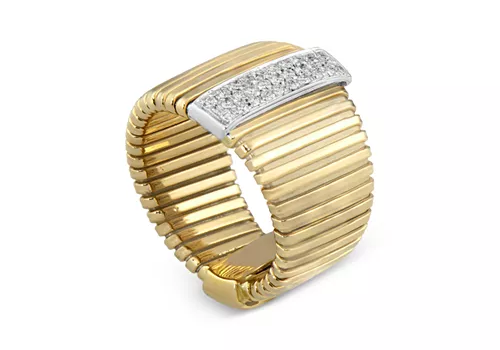
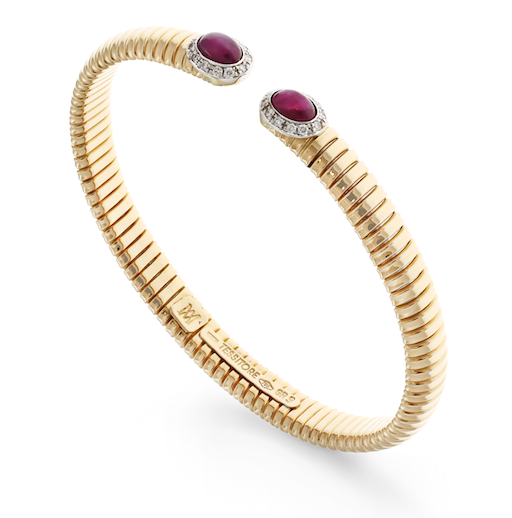
Alberto Milani jewelry brings together gold, precious stones and the 19th-century industrial technique of tubogas (from the Italian for “gas pipe”). The flexible corrugated pipe, patented in 1881 to transport pressurized gas, inspired jewelers as early as the 1920s. But the technique of wrapping metal strips with raised edges around a core, which is then removed to negate soldering, really took off in World War II, when metals and precious stones were scarce and, Milani added, women were working in the factories with the men off at war.
Tubogas jewelry has been a hallmark of Bulgari (pronounced “BUL ga ri”), and it is a feature of Milani’s serpentine designs – at once glamorous and understated – which he said are characterized by wearability and versatility.
Just as Milani’s creations draw on what he describes as the “classic” past and brings it into the present for today’s wearers, so Crivelli takes “a unique, contemporary approach to the diamond market,” said Marilyn Williams, Piazza Italia’s vice president of sales. Meanwhile, Utopia offers pearls – another staple of your mother’s and grandmother’s jewelry boxes – for a new generation, Milani added.
He is particularly attuned to using yesterday to entice today’s consumers, offering praise for Bloomingdale’s latest campaign, an ode to the 1970s called “Just Imagine.” For Milani, the ’70s was an era of self-expression whose culture has had a strong influence on his work.
Last year, he and Bloomingdale’s partnered on “From Italy, With Love,” with brands celebrating a variety of Italian industries. It is a mutual admiration society, he said:
“They value my experience, and I value them.”