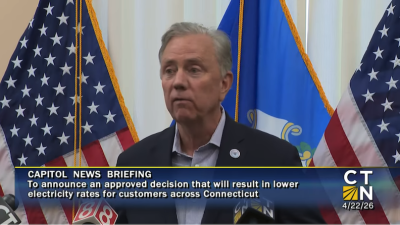
HARTFORD – On the same day Gov. Ned Lamont announced a wave of over 50 endorsements from municipal leaders across Connecticut, he held a press conference to say he also had some good news for United Illuminating (UI) and Eversource electric customers regarding lower bills starting May 1.
The state Public Utilities Regulatory Authority (PURA) approved interim rate decisions (Eversource and UI) that will lower residential electricity rates throughout Connecticut, including by 4.3 cents per kW-hour or about $30 per month for an average Eversource residential customer and 4.9 cents per kW-hour or about $34 per month for an average United Illuminating residential customer.
This reduction is driven by a decrease in the public benefits charge, which will now be a credit on ratepayers’ bills – rather than an additional charge – through at least September, Katie Dykes, commissioner of the state Department of Energy & Environmental Protection, announced.
“The decrease in the public benefits charge is, in large part, due to the contracts Lamont negotiated with the Millstone and Seabrook nuclear power plants, which provide energy at fixed prices and insulate ratepayers from volatile fossil fuel pricing,” she added.
Connecticut’s nuclear contracts have saved Connecticut ratepayers more than $250 million in 2025 and more than $200 million so far in 2026. The Revolution Wind power purchase agreement is expected to save customers a further $100 million per year once fully operational.
She also cited legislation approved by the legislature and signed into law by Governor Lamont in 2025 that has further reduced the public benefits charge. Bonding for hardship and arrearages, as well as electric vehicle charging costs, removed more than $155 million from the public benefits charges in 2025-2026 and $145 million in 2026-2027.
“Let me tell you a little bit about how this happened,” Lamont said. “It wasn’t just by happenstance. When I first came into office, Millstone, our nuclear power plant, was threatening to pull the plug and end nuclear power in this state. It wasn’t an idle threat. We said we were going to step up and do what we can to keep this plant going. We made them a deal. We said almost 5 cents a kW hour. We’ll guarantee that. If price of electricity is less than that, we’ll eat it. If it’s more than that, we’ll get the benefit.”
“Now, every time Putin and Trump invade another country or we have an extremely cold winter, the price of electricity has gone through the roof, that hedge has made us — meaning me and you — about $250 million last year and $200 million this year and counting,” he added. “That means we have been able to eliminate the public benefits charge for the foreseeable future. And with that means is that instead of the public benefits charge being about 4 cents on your bill, now it’s going to go down as a 1 cent credit.”
Connecticut Consumer Counsel Claire Coleman said while there is still more work to do, these actions reflect a balanced approach that lowers costs, strengthens the system, and makes energy more affordable for Connecticut families
“By utilizing bond funding to address pandemic-era arrearages, we’re reducing costs for all ratepayers while helping thousands of households move beyond the burden of past-due bills,” Coleman said. “At the same time, programmatic improvements to the low-income discount rate and arrearage forgiveness options are ensuring that relief is targeted and reaches those who need it most.”
PURA may make further adjustments to these approved rates effective Sept. 1, including adjustments based on its prudence review of 2025 costs, the authority said in its interim decisions. It ordered Eversource and UI that no later than April 24, the company (ies) shall submit a clean and redlined version of all tariffs reflecting the rate adjustments directed herein for the NBFMCC, TAC, SBC, and RDM rates, effective May 1, for authority review and approval. The Company shall also file supporting exhibits with the rate calculations in an unlocked worksheet. In the supporting exhibits, UI shall apply the prime rate to calculate the carrying charges for the applicable rate components, the ordered continued.
Meanwhile, only hours before the press conference Lamont’s political arm released a press release announcing endorsements from Democratic municipal leaders. The message in that release was that Lamont has been doing all he can to make the state more affordable for residents.
“From our cities to our small towns, people are coming together because they’ve seen the real progress we’ve made and they believe in where we’re headed,” he said. “I’ve been proud to partner with mayors and first selectmen across Connecticut, working side-by-side to strengthen our communities, support our schools, and deliver real results for families.
“Together, we’ve helped our cities grow stronger, our towns thrive, and our state move forward. This broad coalition reflects that shared progress, and I’m deeply grateful for their support as we keep building a more affordable, more opportunity-filled Connecticut.”
Lamont, who has been governor since 2019, is seeking reelection to a third term. He faces a possible primary from state Rep. Josh Elliott (D-Hamden). The Republican candidates include former New Britain Mayor Erin Stewart, state Sen. Ryan Fazio, (R-Greenwich) and former New York state Lt. Gov. Betsy McCaughey, a NewsMax TV host who now lives in Greenwich.