When you think of viable careers, the word “artist” doesn’t necessarily leap to mind.
According to the U.S. Bureau of Labor Statistics, the median annual wage for fine artists (including painters, sculptors and illustrators) was $56,260 in May 2024, or about half you would need for a comfortable lifestyle in Westchester and Fairfield counties. (However, some artists earn significantly more, with the top 10% making more than $133,220 a year.)
In the 1960s and ’70s, earnings for artists – generally defined as male artists – declined even as the contemporary art market grew. This is the story of a woman, a young wife and mother of three in that period, who knew she couldn’t make a living as an artist and instead widened her perspective.
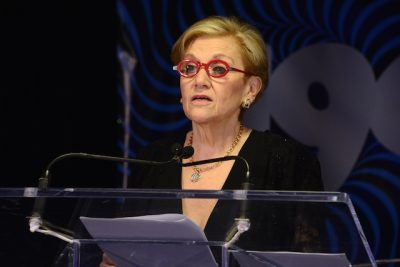
“I was painting on a broader canvas,” said Janet Langsam, CEO emerita of ArtsWestchester in White Plains. “I was using my creativity to advocate for the arts and women in the arts.”
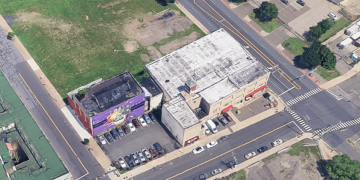
We interviewed Langsam in her sixth-floor studio at 31 Mamaroneck Ave. in White Plains, the historic 12-story building – it opened as the People’s National Bank & Trust Co. in 1929 – that ArtsWestchester acquired under her leadership in 1998 as a creative space for other businesses as well. During her 33-year tenure (1991-2024), she spearheaded fundraising efforts that secured more than $75 million for the arts as the arts council’s annual budget grew from $1 million to nearly $7 million. When the pandemic hit in 2020, she rallied the broader arts community by securing $10 million annually for upstate arts councils and $1 million in state funds for ArtsWestchester’s Restart the Arts Program.
The former CEO is now a tenant, but she remains a powerhouse of civic-minded ambition and a keen observer of the struggles the arts are enduring in the current cultural climate. On May 15, ArtsWestchester launched a crowdfunding campaign in response to $285,000 in federal grant terminations affecting several of the organization’s initiatives.
“It’s not just a funding issue,” she said. “It’s a moral issue. It’s about what kind of world do we want to have and want to live in. It’s a denial of the global effort and experience,” added the woman who defines herself as a globalist, a patriot and a feminist, if an improbable feminist at that.
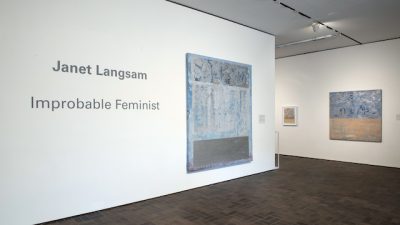
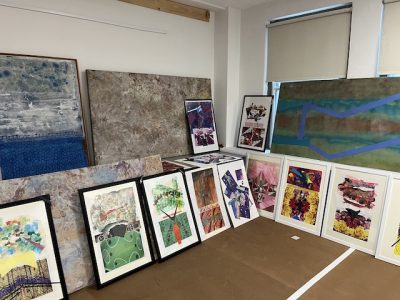
“Janet Langsam: Improbable Feminist” was the title of her recent retrospective at the Neuberger Museum of Art at Purchase College. The school was established in 1967 by Gov. Nelson A. Rockefeller to serve as an arts conservatory within the State University of New York’s (SUNY) network of 64 universities and colleges. Seven years later, the museum was founded with a core collection from financier Roy R. Neuberger, one of the 20th century’s great collectors and philanthropists. It now has nearly 7,000 objects, to which it will be adding five of Langsam’s paintings. Her works include canvases done in acrylic paints, a fast-drying, versatile medium that does not require priming the canvas; collages made of photographs and paint; and assemblages, three-dimensional collages of found objects.
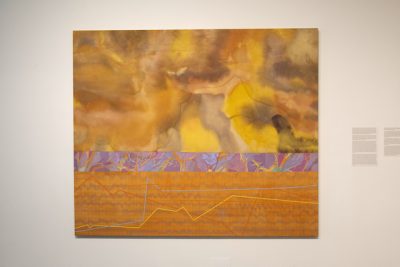
“The show at the Neuberger gave me the opportunity to think about what the paintings were about,” Langsam said. A particularly striking theme – the horizon in trisected abstract canvases, often in silvery grays and light blues that suggest sand, sea and sky.
Growing up in Far Rockaway in Queens, the child not only of a teacher and a salesman of velvet fabrics but of the Great Depression and World War II, when the inescapable news stories of not-to-distant horrors vied with “Tom Mix Ralston Shooters” and “The Shadow” on the family’s mahogany radio, Langsam saw the beach as an escape and a refuge. It was the family’s air conditioning in summer, and “in the autumn, when it was just a little chilly, we would go down to the beach and tuck ourselves in the warm sand that had been heated by the sun earlier in the day,” she recalled in the exhibit text. “The one constant presence was the horizon, and it belonged to us. Although it changed daily in color, line and form, we could count on the fact that it would be there every day in one form or another. The tranquility, the beauty, the safety and the quietude and the sense that it would go on forever was the gift that was ours because of where we lived.”
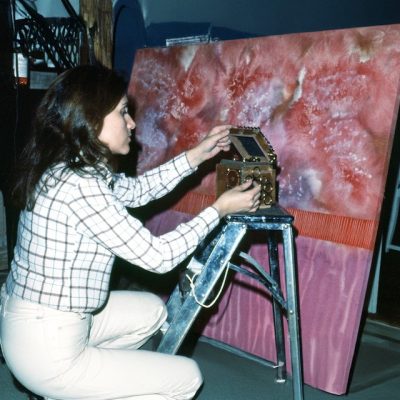
Another gift – the arts through a variety of music lessons and trips to The Metropolitan Museum of Art. “Nothing ever stuck, but in retrospect…everything stuck.” New York University, where Langsam got a degree in journalism and English literature, would be the entrée not only to jobs on The Rockaway Wave, the Long Island Press and House Beautiful but to the Greenwich Village arts scene and Abstract Expressionism, in which colors and shapes, rather than figures, carry the narrative. Studying with Gregorio Prestopino, an Italian artist in the vernacular of Romare Bearden and Ben Shahn, whose works served as social commentary, and abstract painter-collagist Leo Manso; and using acrylic paints, Langsam found that “the door swung wide open for me, and I understood that ‘yes, I can be an artist.’”
Still, she added, “I was torn between art and being a wife and a mother.” A third avenue was about to show her a way through. It began with her participation in the League of Women Voters (LWV) and blossomed into a role with Queens Community Board 7, which she would eventually chair. By the time The New York Times came calling with a profile of her, “A Day in the life of a Nonstop Housewife” (Jan. 15, 1972), Langsam was an artist, art teacher, wife, mother and planning board chairwoman.
“It was great being featured,” she recalled in the Neuberger show, “but I really didn’t care for the headline. I mean, really… ‘A Day in the Life of Nonstop Housewife?’ Here I was, a leader in the community, exhibiting my artwork, teaching…. That headline framed everything I was doing –everything I was – within the context of being a housewife. I was a housewife, and proud of that part of my life, but it was just one part of my life.”
By then, the feminist movement, which for Langsam had been sharpened by the civil rights initiatives of President John F. Kennedy and his untimely death, was in full swing. So was another part of her life, advocating for a museum for her home borough. The Queens Museum opened in Flushing Meadows-Corona Park near what is now the USTA Billie Jean King National Tennis Center in 1972 in a building repurposed from the 1939 and’ 64 Worlds Fairs, and Langsam would soon be chair of its board. Her community activism, however, had also brought her into the orbit of Mayor John V. Lindsay, a moderate Republican who was interested in decentralizing New York City’s vast government. Langsam took a position in his administration as district manager for the Rockaways in the Office of Neighborhood Government. It would prove a turning point and a springboard to a life in arts administration.
“My work under the Lindsay administration helping to decentralize government and share decision-making with the community at the grass roots level was my first step in realizing the power of artists in community,” she said in the Neuberger exhibit. “I firmly believe that art is not just something that one can see in a museum or hear at the opera. Art training should be not just to produce artists that will perform on Broadway or show in museums. All communities need artists working within them. All people benefit from art – the young, the elderly, the disabled. I introduced these ideas of community building and access to the arts early on in my career, decades before ‘community engagement’ became a buzz word.”
Langsam, who would go on to serve as first deputy commissioner of the city’s Department of Cultural Affairs – she had lobbied for its separation from the Department of Parks and Recreation and had taken a pay cut for the job – under Mayors Abe Beame and Ed Koch and as assistant housing commissioner in the Koch administration, developing artist home ownership in New York City.
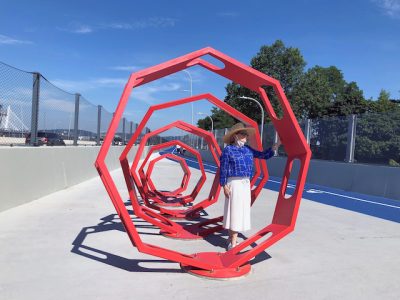
The arts and real estate are inextricably linked, she told Westfair. As president and CEO of the Boston Center for the Arts, she oversaw the development of artist housing, studio spaces and a home for the Boston Ballet Company. At ArtsWestchester, she placed artwork in hospitals, corporations and especially public spaces, putting more than $1 million in the hands of artists who created public art.
Simultaneously, she developed school programs and curriculum and brought the arts to the mental health community and senior citizens.
Now she has come full circle. The girl from Far Rockaway still chases the horizon in collages that juxtapose painted images with photographic ones. The arts advocate is advocating for her own works.
She does so with macular degeneration, a condition that robs the sufferer of her central vision. It would seem to be a particular cruel blow for an artist, something that Henry James or Graham Greene might’ve conjured for one of their characters. But Langsam takes it in stride, using a number of devices, from thick glasses to apps that read to you, and getting up close and personal with her work. Besides, she said, she is even busier now than when she was leading the arts council.
For Langsam, the horizon has not dimmed. The light endures.