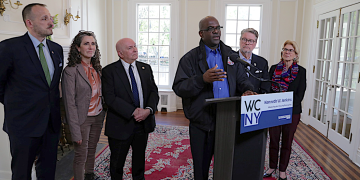
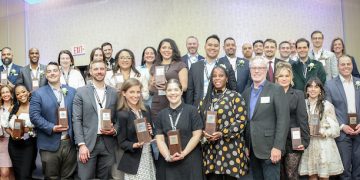
WHITE PLAINS, NY – When you think about all the development taking place in Westchester, Rockland, and Fairfield counties as well as the Hudson Valley, one of the first things that comes to mind is how and why do developers do it. Sure, many think it’s about the money. But that’s not the only reason.
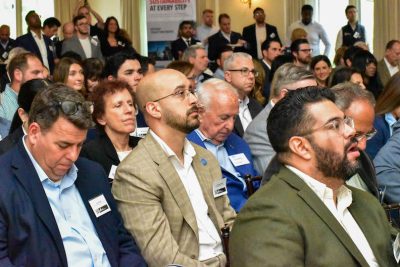
“Developing these projects is very much like having a child,” Joe Simone, president of Simone Development Companies, told a crowd of more than 150 people at C.V. Rich Mansion in White Plains Thursday. “You have to think very hard whether you want to do it or not. Then there’s a lot of pain that goes with the process and then when the project is completed it’s like one of your children.
“Once that occurs there’s that love and feeling that you have for it. You want it to be good, not only as a project monetarily and financially, but you want it to stand tall and be something that can really help people.”
Simone was one of five panelists who led the discussion at Westfair Communications’ 2025 Real Estate event “Building Opportunities: Navigating Our Counties’ Real Estate.” Westfair is the parent company of Westfair Business Journals. covering business in Westchester and Fairfield counties. The other speakers included Sadie McKeown, president of The Community Preservation Corp.; Mark Stagg, founder and principal of the Stagg Group; Clay Fowler, chair and CEO of Spinnaker Real Estate Partners LLC; and Lynne Ward, president of National Resources. Village of Pelham Mayor Chance Mullen was the moderator.
Partnering sponsors for the event included AVE Korman Communities, Cappelli Organization, RM Friedland Commercial Real Estate Services and Whitaker’s Garage Door Store. Supporters: Atlas Adjustments, BRI: The Building & Realty Institute, CCLEAN – Cleaning for Health, Community Preservation Corporation, EWHowell Construction Group, Lucid, Turner Construction, WIN Waste Innovations, Stagg Group, Paraco, RTK Environmental Testing, and Sharc Creative.
Community builders
While these developers and commercial property financiers have made a living redeveloping aging buildings and putting up new ones, they consider themselves community builders first and foremost.
“Whether we like it or not, the built environment around us will quietly govern the trajectory of our lives and the lives of generations after us,” Mayor Mullen said. “As mayor, I know I have on outsized role in answering the questions: where do I work? and where do I sleep? That is why we are on track to expand our housing stock by 8%, we’ve added millions in value to our downtown, we’ve made investments in core infrastructure.”
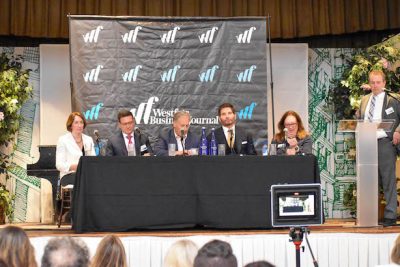
McKeown gave an example of how a redevelopment project came together in New Rochelle after many years.
“When we financed the Bloomingdale’s building in New Rochelle, it had been a white elephant and it was vacant for many years,” she said. “I was walking down the street with the then president of the CPC, and he said we can finance this. But stop and take a look around. Look at all the small buildings and small property owners. They have been here for decades. They have been waiting for this investment.
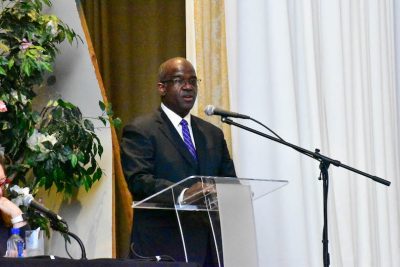
“So, we created the Downtown New Rochelle Redevelopment Program in the Business District, where we invested not just by making loans but making grants to all the business owners so they could have housing above their store and improve their facades.”
Fowler added that the transformational part of developments is key to what keeps him doing what he has been doing for more than 30 years.
“It’s whether it is transformational,” he said. “We do a lot of the other jobs. But one of the jobs I’m most proud – we didn’t make a dime – was a transformation job in St. Louis. We rehabbed a large former Dillard’s department store in downtown.
“We bought the downtown Simon Mall next to it. We transformed that into apartments, an Embassy Suites hotel, a Blues music museum. Then we turned the mall inside out where the retail is outward facing and the interior mall is a garage.”
While Fowler started out as a developer in Westchester County, he has since set down roots in Connecticut. It is here where he has seen success in redevelopment projects in both Fairfield and Hartford counties.
“We do adaptive reuse of former office buildings,” Fowler said. “We have a pretty big one going on in Hartford at the former site of the Attorney General’s and Treasurer’s offices. We work primarily in Connecticut, not exclusively.”
Affordable housing
Affordable housing, or what many now call “workforce” housing, is something all the developers and financiers at the Westfair event have some involvement. And they described some of the obstacles they face from neighbors of such developments.
“I just don’t get it in Westchester where people get skittish and squeamish when you talk about affordable housing,” Stagg said. “This is our workforce. These are households that make between $65,000 and $100,000 a year. These are the people who work in the kitchen at the hospital, that clean the hospital. Why not give that community a chance to have that opportunity?”
Specific projects
Here are some of the prominent projects panelists discussed:
One Executive Boulevard, North Yonkers (Simone Development)

Simone: “We realized that the Broadway corridor diagonally across from St. John’s Hospital was primed to develop outpatient facilities and this will be our third on that strip. That started out as a regular office building. We believe very strongly in adaptive reuse. We felt that would be perfect to adapt to a medical building.”
Q-West Towers, Mount Vernon (Simone Development)
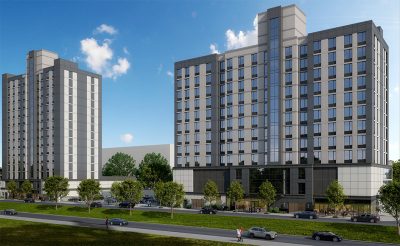
Simone: “I happen to be partners with one of the people on this stage and that is Mark Stagg. That had been urban blight for a very long time. I was very familiar with the area since I grew up there. We tried to do something that would stimulate the economy there and anchor the area. We started about 10 years ago assembling some sites. Very shortly, we will building 249 housing units.”
Anthem Square 10, New Haven (Spinnaker Real Estate)

The Villages at Saugatuck, Westport (Spinnaker Real Estate)
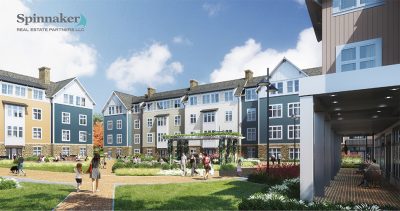
Fowler: “We are working on several jobs now. There’s the former coliseum site in New Haven. That’s the first phase of what will be 600 or 700 units. We opened up a restaurant yesterday (Wednesday, May 15) – the Melting Pot. Then there is The Villages at Saugatuck is God’s work. It’s in Westport – God’s country.” He mentioned that the 157-unit Westport project is what is known as an 8 30 (g) – a state statute that can override local zoning opposition if the project includes 30% affordable housing.
One Dromore Apartments, Scarsdale (CPC).

McKeown: “This is 100% affordable and took 15 years and several lawsuits to get approved. It is a beautiful project that many people want to call their own after years they didn’t want it in their backyard.
The Marquee, 697 Bronx River Road, Yonkers (Stagg Group)
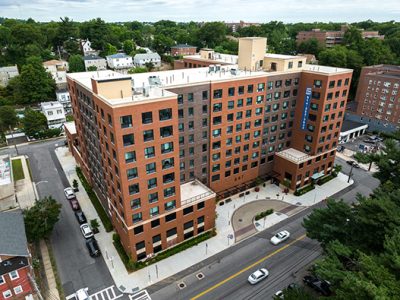
Stagg: “That’s 160-unit market rate apartment building. This was a unique opportunity. We called it the ‘missing tooth.’ There were pre-WWII buildings up and down Bronx River Road. We were able to do an assemblage. It took time. We built it in Covid and it’s got a 10% affordable component that Yonkers requires.”
67 Grant Ave., Harrison (Stagg Group)

Stagg: “This is a project that we changed the zoning. We had owned the building. There was a little bit of uproar about where it is located near Beaver Creek. We’re addressing all the concerns. It’s what the town of Harrison voted for. They wanted to bring residents downtown.”
As for the future, Mayor Mullen posed one final question to the panelists. “As you look at the time ahead, where do you see the biggest threats for the work that you do and what are you doing to alleviate those threats?” he asked.
“The bottom line is tune out the noise and keep doing what you are doing,” Fowler said. “The biggest threat I feel in my business is interest rates. Who’s kidding who? I started a business a long time ago in 1978. Interest rates then came down from 18% to 10%, then the country boomed. Yes, they are high now compared to what they were. But they are still relatively low. We need to readjust, reengage our expectations of our investments.”
Ward of National Resources, who touts her British roots, is worried about the litigious American society.
“I think we need less litigation culture,” she said. “That’s getting in the way of a lot of these developments. It’s affecting the banking, insurance rates. Somewhere along the line, we need to make the young people more creative and less legislative. That’s a tall order. That will make America like the forefather that the people here wanted.”