Against the background of the Trump Administration moving to reduce funding for a variety of federal agencies and private sector organizations that provide social programs, more than 200 nonprofit, health care, government and business leaders from the Westchester area attended an event staged by Nonprofit Westchester that examined the importance of nonprofits.
The event was titled, “Strengthening Westchester’s Health and Economy: New Data Revealed.”
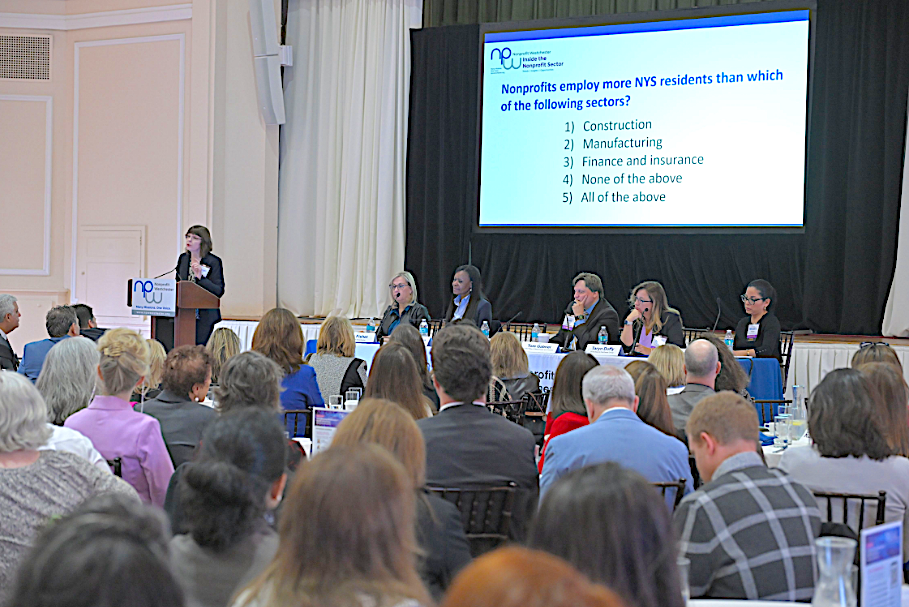
“The health of the nonprofit sector is critical to the social and economic health of Westchester County,’’ Nonprofit Westchester Executive Director Jan Fisher said during the program at the C.V. Rich Mansion in White Plains. “Yet this impact is not fully understood or capitalized on. Today we are here to increase that understanding as well as opportunities to strengthen our community.’’
Fisher said for nonprofits to remain strong and sustainable the state needs to reform an inefficient contracting system where payments are chronically late. She said that the nonprofit sector needs to be able to offer more competitive salaries to nonprofit workers to attract and keep quality talent. She urged the business sector to collaborate with nonprofits on advocacy efforts, including pressing for these essential contracting reforms. Fisher emphasized that strengthening the nonprofit sector is a business and economic issue that affects the entire community, not just the nonprofits themselves.
Megan Allen, CEO of the New York Council of Nonprofits, said that as of last December there were mire than 119,000 nonprofits in New York state, which account for more than 1.3 million jobs. In Westchester, that number is about 56,000 or 16.2% of the workforce, she said.
Tom Gabriel, president and CEO of the United Way of Westchester and Putnam, said that recent proposed federal cuts triggered by Donald Trump’s executive orders would not only devastate vulnerable populations that receive assistance, but result in a loss of jobs that would strike a blow to the economy.
“When you are cutting food stamps, SNAP benefits, etc., there are people who administer those programs, those are jobs,” Gabriel said. “There is so much uncertainty around some of these executive orders and in some cases, the rule of law is not being followed, they are just being implemented.”
Gabriel said executive orders have targeted basic services such as $1 billion to help schools and food banks purchase food. He cited proposed cuts that would make 12 million children ineligible for school meals. In addition, more than 42 million Americans would be affected by cuts to SNAP or food stamps as well as cuts to the Federal Emergency Management Agency (FEMA) that would cause Westchester to lose $500,000 from its Emergency Food and Shelter program.
Monica Hidalgo, corporate director of community relations for NewYork Presbyterian, and Taryn Duffy, founder and president of Tarsam Public Affairs, both discussed how businesses and hospitals work with nonprofits to keep the community healthier and advance other people-focused goals.
Hidalgo said that NewYork Presbyterian, like other hospitals, uses data to determine how they can best support a community’s health needs. She said NewYork Presbyterian invested nearly $1 million in Westchester this past year to support programs to combat food insecurity and support maternal child health.
Duffy, who worked for MGM and Empire City in public affairs and community outreach for many years, said that data shows that corporations benefit from philanthropy, enjoying broader support from consumers and employees when they do good work.
“The benefits of corporate social responsibility touches every area of the business, everything from investor relations and brand reputation to customer loyalty and workforce engagement,” Duffy said.
Michael Schiliro, senior vice president of PCSB Bank said it was not only the business community’s responsibility to help support nonprofits, but it makes good financial sense.
“We need to pay attention to how we can better improve society. At PCSB Bank we are proud of being engaged in the nonprofit community for over 150 years,” Schiliro said.
Westchester County Executive Ken Jenkins delivered the opening remarks for the program.